











Designed to protect what matters
before threats strike.
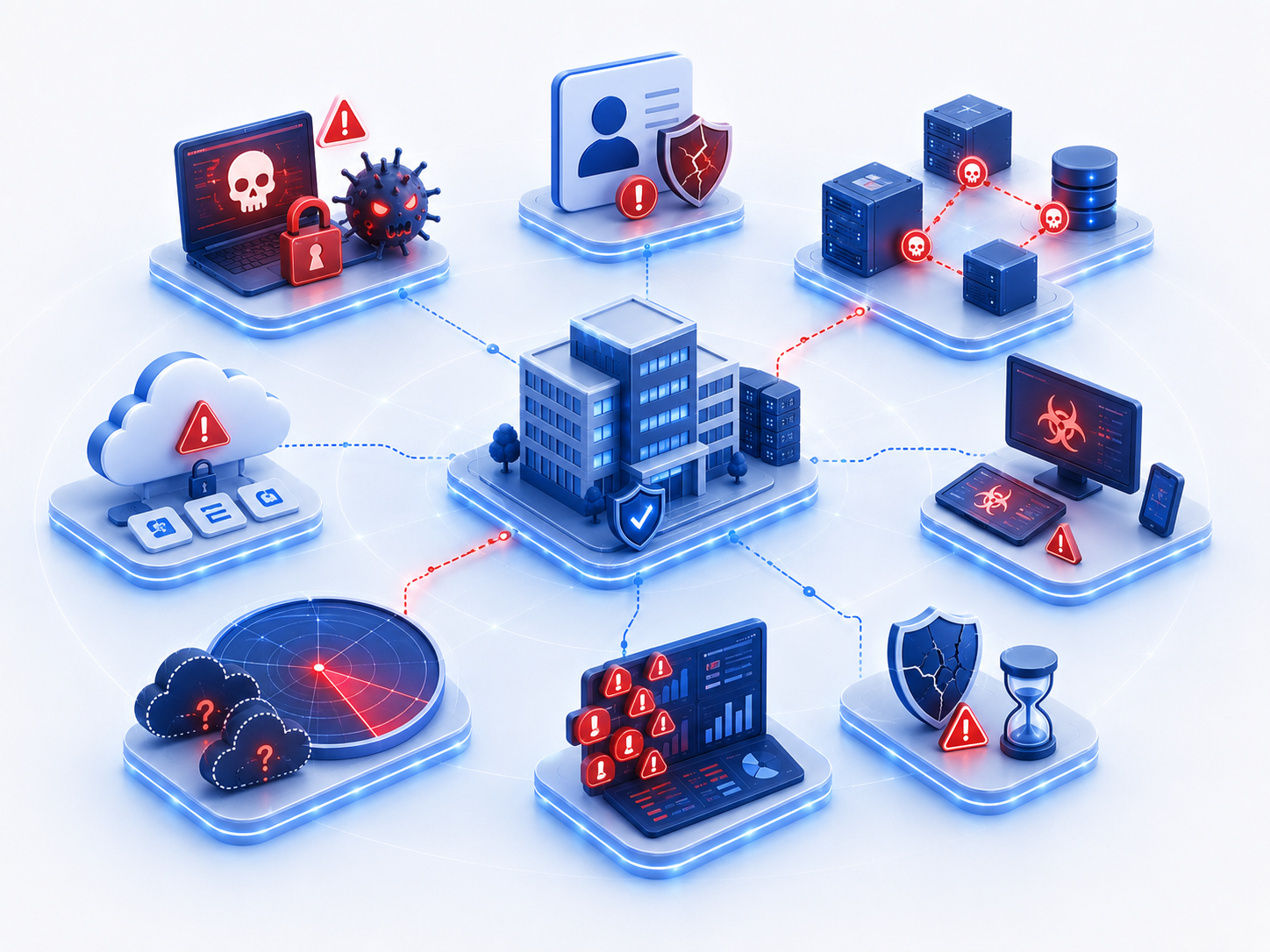
Modern enterprises face ransomware, credential compromise, identity attacks, cloud threats, endpoint intrusion, and lateral movement across increasingly connected environments. Fragmented telemetry, alert overload, detection gaps, and limited response capacity can allow sophisticated threats to remain undetected.
CliffGuard’s Enterprise Managed Detection & Response (MDR) and Extended Detection & Response (XDR) Services combine continuous monitoring, cross-domain detection, expert investigation, threat hunting, and coordinated response to reduce attacker dwell time and strengthen enterprise cyber resilience.
Managed Detection & Response (MDR) provides continuous security monitoring, expert investigation, proactive threat hunting, incident triage, and response support across enterprise technology environments.
Extended Detection & Response (XDR) correlates signals across endpoints, identities, networks, cloud, email, and applications to improve threat visibility and expose multi-stage attack activity.
CliffGuard combines MDR operations, XDR telemetry, detection engineering, threat intelligence, and MITRE ATT&CK-informed analytics with incident-response practices aligned to NIST CSF 2.0 and NIST SP 800-61 Rev. 3.

👁️ 24×7 MDR Monitoring & Triage – Monitor security telemetry, validate alerts, prioritize incidents, and escalate confirmed threats.
🔗 XDR Integration & Correlation – Correlate endpoint, identity, cloud, network, email, and security signals across environments.
🧪 Threat Detection & Engineering – Develop detections, tune analytics, improve use cases, and close coverage gaps.
🔍 Threat Hunting & Intelligence – Hunt hidden adversaries, analyze indicators, investigate TTPs, and enrich threat context.
🛡️ Incident Investigation & Response – Determine attack scope, coordinate containment, support remediation, and validate recovery actions.
Define critical assets, monitoring priorities, telemetry requirements, escalation paths, response authority, service levels, and communication procedures. Integrate endpoint, identity, network, cloud, email, SIEM, and XDR data sources to establish effective coverage.
Continuously analyze security events, behavioral signals, threat intelligence, identity activity, endpoint telemetry, network traffic, and cloud events. Correlate related signals across security layers to expose suspicious behavior and multi-stage attacks.
Validate detections, reconstruct attack activity, identify affected assets, determine severity, and assess business impact. Proactively hunt for credential abuse, persistence, privilege escalation, lateral movement, and defense evasion using threat-informed techniques.
Coordinate approved actions including endpoint isolation, account restriction, credential reset, indicator blocking, and access revocation. Support containment, eradication, remediation, recovery, and escalation according to defined incident-response procedures.
Review incidents, telemetry gaps, detection coverage, response performance, and recurring attacker techniques. Tune analytics, improve playbooks, expand monitoring, automate repeatable workflows, and continuously strengthen detection and response effectiveness.
🦠 Ransomware & Malware – Detect malicious execution, persistence, encryption activity, and command-and-control behavior.
🔐 Identity Compromise – Identify credential theft, account takeover, privilege abuse, and suspicious authentication.
🔗 Lateral Movement – Detect abnormal access, remote execution, privilege movement, and attacker propagation.
☁️ Cloud & SaaS Threats – Identify suspicious access, workload compromise, privilege misuse, and cloud attack activity.
🖥️ Endpoint Compromise – Detect malicious processes, exploitation, persistence, and unauthorized endpoint activity.
👁️ Detection Blind Spots – Identify telemetry gaps, missed behaviors, weak analytics, and incomplete security coverage.
🚨 Alert Overload – Reduce noisy detections, duplicate alerts, poor prioritization, and analyst fatigue.

👁️ Greater Threat Visibility – Understand threats, attack activity, affected assets, detection coverage, and exposure.
🚨 Faster Threat Detection – Identify malicious activity earlier and reduce attacker dwell time and impact.
🛡️ Improved Incident Response – Accelerate investigation, containment, remediation, recovery, and incident coordination.
🎯 Reduced Alert Fatigue – Prioritize actionable threats and reduce unnecessary analyst workload and noise.
⚙️ Stronger Security Operations – Improve detection quality, automation, response consistency, and operational efficiency.
Managed Detection and Response (MDR) is a fully managed cybersecurity service that continuously monitors your environment, detects advanced threats, and responds to incidents in real time. MDR combines 24/7 threat monitoring, human-led investigation, and rapid response to reduce breach risk and attacker dwell time.
Extended Detection and Response (XDR) unifies security data from endpoints, networks, cloud platforms, identities, email, and applications. By correlating events across multiple layers, XDR improves threat visibility, reduces false positives, and enables faster, more accurate response—making MDR more effective.
Unlike SIEM or EDR alone, MDR/XDR provides end-to-end threat detection, investigation, and response—not just alerts. It combines advanced analytics with expert human response, eliminating alert fatigue and ensuring real threats are acted on immediately.
MDR/XDR protects against ransomware, malware, phishing, credential theft, insider threats, cloud attacks, lateral movement, zero-day exploits, and advanced persistent threats (APTs) by detecting attacker behavior across the entire attack surface.
Yes. Modern MDR/XDR services are designed to secure on-prem, cloud, and hybrid environments, including SaaS applications and remote workforces. This makes MDR/XDR ideal for organizations undergoing digital transformation.
Response times depend on severity, but MDR/XDR is built to detect and respond to critical threats in near real time. By reducing Mean Time to Detect (MTTD) and Mean Time to Respond (MTTR), MDR/XDR minimizes damage and business disruption.
Analysts establish scope and impact, escalate confirmed incidents, and coordinate approved containment, access restriction, remediation, recovery, and response actions.
CliffGuard combines Enterprise MDR, XDR correlation, threat hunting, detection engineering, and coordinated response to transform fragmented security telemetry into actionable intelligence, faster containment, and measurable cyber risk reduction.
Gain continuous visibility across your enterprise attack surface. CliffGuard identifies sophisticated threats, investigates attack chains, accelerates containment, and strengthens detection and response capabilities against evolving adversary behavior.