











Designed to protect what matters
before threats strike.
Modern enterprises manage growing numbers of employees, contractors, partners, applications, cloud platforms, devices, and non-human identities. Fragmented identity systems, weak authentication, excessive access, legacy protocols, and inconsistent lifecycle controls can increase the risk of unauthorized access and account compromise.
CliffGuard’s Identity & Access Management (IAM) Services help organizations modernize identity architecture, strengthen authentication, implement secure access controls, streamline identity lifecycle processes, and establish consistent access enforcement across hybrid and multi-cloud environments.
Identity & Access Management (IAM) is a cybersecurity framework that governs user identities, authentication, authorization, and access controls across your IT ecosystem. IAM ensures that employees, partners, contractors, and systems can securely access resources—while blocking unauthorized or risky access.
CliffGuard’s IAM solutions cover the full identity lifecycle, including identity provisioning, authentication, access governance, privileged access management (PAM), and continuous monitoring—all aligned with zero-trust security principles.
🔐 The goal: reduce identity-based attacks, eliminate excessive access, and strengthen compliance.

🧭 IAM Strategy & Architecture – Design identity operating models, platforms, directories, trust relationships, and modernization roadmaps.
👤 Identity Lifecycle & Provisioning – Automate onboarding, role changes, provisioning, deprovisioning, and identity synchronization.
🔐 MFA & Passwordless Authentication – Implement strong authentication, passkeys, adaptive access, and phishing-resistant controls.
🔗 SSO & Identity Federation – Enable SAML, OIDC, OAuth, federation, and secure application access across environments.
🛡️ Access Control & Authorization – Implement RBAC, ABAC, conditional access, least privilege, and policy-based enforcement.
Define identity populations, business applications, critical resources, assurance requirements, access risks, regulatory obligations, and ownership models. Assess existing directories, identity providers, authentication methods, access policies, and integration dependencies to establish the target IAM architecture.
Establish authoritative identity sources, enrollment processes, identity attributes, lifecycle workflows, and provisioning rules. Automate joiner, mover, and leaver processes to create, update, synchronize, and remove access consistently across connected systems.
Implement authentication appropriate to risk using MFA, passwordless methods, adaptive controls, and secure authenticator management. Define authorization through roles, attributes, contextual policies, least privilege, and separation-of-duties principles.
Integrate identity providers, applications, cloud platforms, APIs, and directories using secure federation and provisioning patterns. Enforce access policies through SSO, SAML, OIDC, OAuth, conditional access, and centralized policy controls.
Monitor authentication activity, access decisions, lifecycle events, exceptions, and policy effectiveness. Validate provisioning and deprovisioning, review access controls, identify identity drift, and continuously improve IAM security, usability, and operational performance.
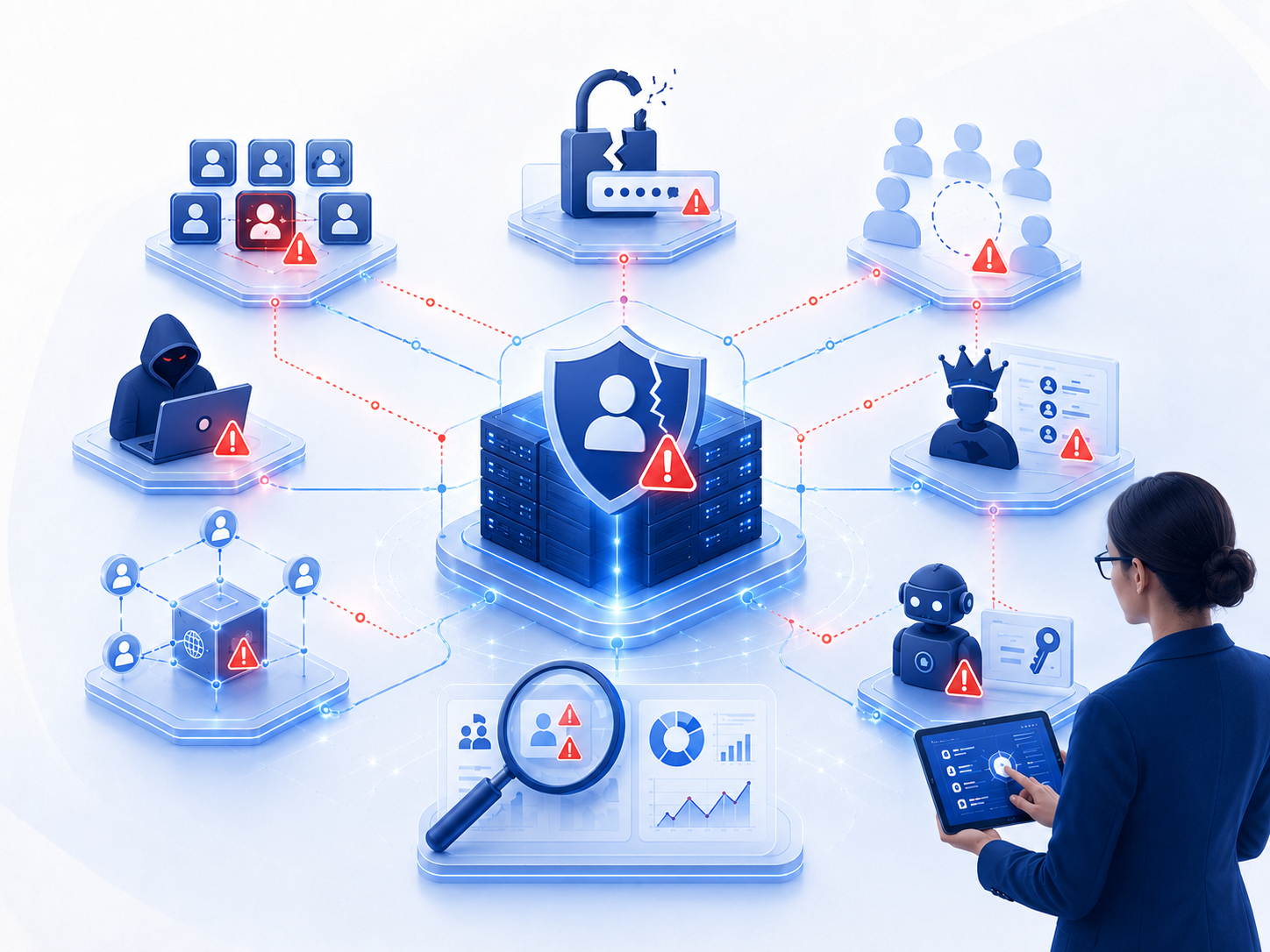
🔓 Excessive Access – Identify broad permissions, inappropriate roles, privilege accumulation, and unnecessary access.
🔐 Weak Authentication – Reduce password dependence, weak MFA, legacy authentication, and account-takeover exposure.
👤 Orphaned Identities – Detect inactive users, terminated accounts, unmanaged identities, and unclear ownership.
🔗 Federation Weaknesses – Identify insecure trust relationships, misconfigured SSO, assertions, and application integrations.
⚙️ Lifecycle Control Gaps – Address delayed provisioning, deprovisioning failures, access drift, and inconsistent processes.
🤖 Non-Human Identity Risk – Identify unmanaged service accounts, application identities, credentials, and excessive permissions.
🛡️ Inconsistent Access Policies – Detect fragmented authorization, weak conditional access, and poor least-privilege enforcement.
📊 Limited Identity Visibility – Improve oversight across identities, authentication, access decisions, exceptions, and activity.
🔐 Stronger Access Security – Reduce unauthorized access, credential abuse, weak authentication, and identity compromise.
👤 Improved Identity Lifecycle – Accelerate onboarding, access changes, deprovisioning, and identity synchronization.
⚙️ Greater Operational Efficiency – Automate identity workflows and reduce access-management overhead.
🛡️ Reduced Identity Risk – Minimize excessive access, orphaned accounts, weak controls, and policy inconsistencies.
📋 Improved Compliance Readiness – Strengthen access evidence, policy enforcement, lifecycle controls, and accountability.
Identity & Access Management (IAM) ensures that only authorized users, devices, and applications can access enterprise systems and data. IAM is critical because identity-based attacks are a leading cause of data breaches, making strong access governance essential for security, compliance, and risk reduction.
IAM reduces breach risk by enforcing least-privilege access, strong authentication (MFA), continuous identity monitoring, and privileged access controls. These measures prevent unauthorized access, lateral movement, and misuse of compromised credentials.
Core IAM capabilities include Identity Governance & Administration (IGA), Privileged Access Management (PAM), Multi-Factor Authentication (MFA), Single Sign-On (SSO), identity threat detection, and continuous access reviews across on-premises and cloud environments.
IAM helps meet compliance requirements such as GDPR, HIPAA, ISO 27001, SOC 2, and PCI DSS by providing access visibility, audit trails, policy enforcement, and automated access certifications. This enables organizations to demonstrate control effectiveness during audits.
IAM is foundational to Zero Trust by continuously verifying user identity, device posture, and access context before granting or maintaining access. It enforces “never trust, always verify” principles across users, applications, and data.
IAM limits insider risk by enforcing role-based access, monitoring user behavior, securing privileged accounts, and requiring approvals and session controls for high-risk access. This reduces both malicious and accidental misuse of access.
IAM effectiveness is measured through reduced identity-related incidents, faster access provisioning and deprovisioning, successful audit outcomes, improved visibility into access rights, and alignment with business risk and security maturity goals.
CliffGuard combines IAM strategy, identity architecture, authentication modernization, federation, lifecycle automation, and access-control engineering to reduce identity risk while improving secure and efficient access across enterprise environments.
Modernize enterprise IAM with stronger authentication, consistent access policies, automated identity lifecycle controls, secure federation, and integrated identity services that protect critical applications, reduce identity risk, and enable trusted business access.