











CliffGuard vs Traditional BAS
Real Adversary Validation
Organizations invest in EDR, SIEM, firewalls, identity security, cloud controls, and detection technologies to stop cyber threats. However, configuration gaps, control failures, weak detections, and untested attack paths can leave critical assets exposed despite significant security investment.
CliffGuard’s Breach and Attack Simulation (BAS) Services safely emulate real-world adversary techniques to validate security controls, identify detection gaps, measure defensive effectiveness, and prioritize improvements across endpoints, networks, identities, cloud environments, and critical systems.
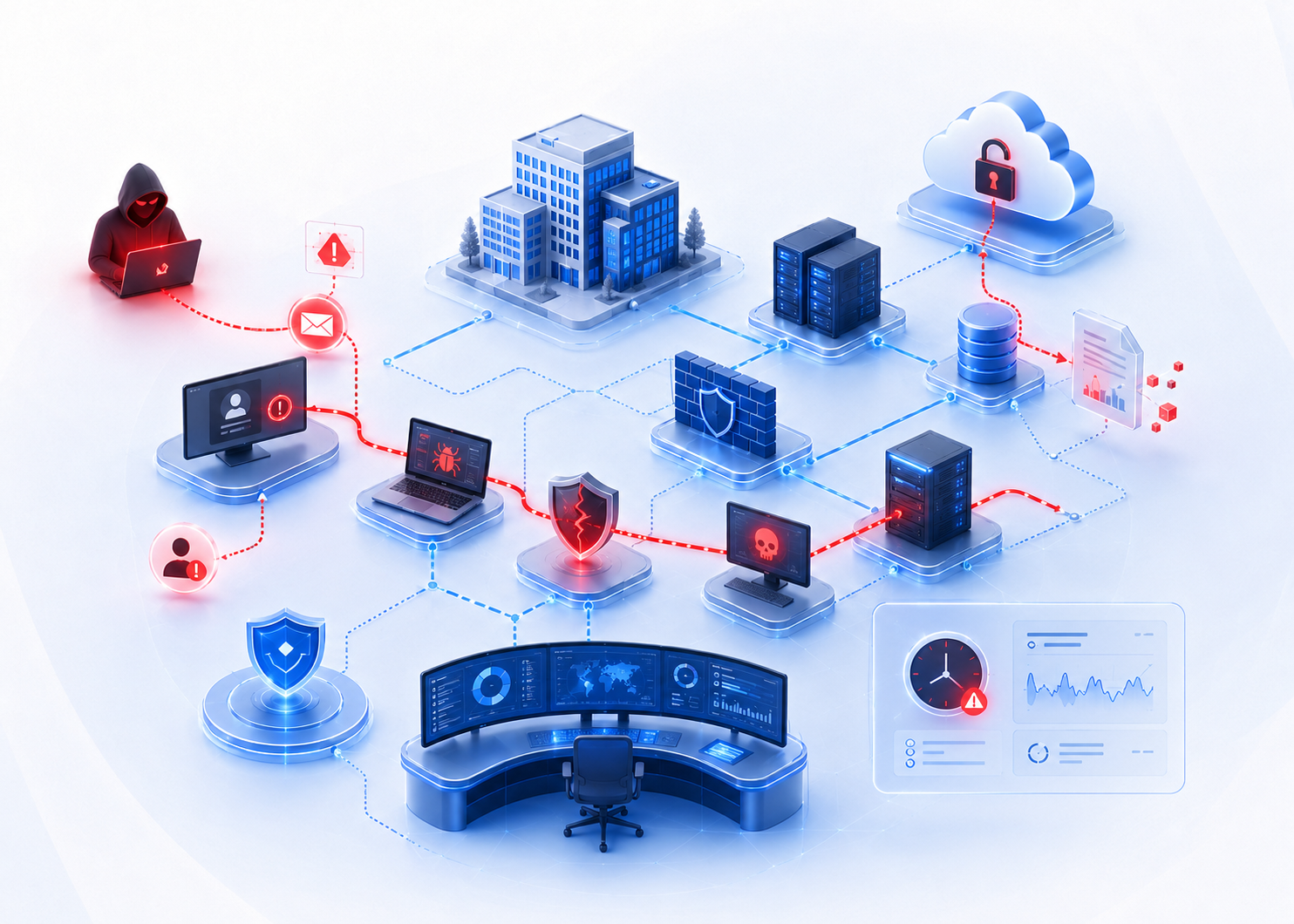
Breach and Attack Simulation (BAS) uses controlled, repeatable attack scenarios to test how effectively enterprise security controls prevent, detect, and respond to adversary behaviors.
BAS evaluates endpoint, network, email, identity, cloud, and security-monitoring controls against realistic attack techniques without requiring a full-scale penetration test for every validation cycle.
CliffGuard combines MITRE ATT&CK-aligned simulations, control validation, detection analysis, attack-path testing, and executive reporting to expose defensive gaps and drive measurable security improvement.

🎭 Threat-Informed Attack Simulation – Reproduce adversary behaviors, attack techniques, business scenarios, and targeted compromise paths.
📧 Email & Initial-Access Testing – Validate phishing defenses, malicious attachments, links, payload controls, and user-reporting workflows.
🔐 Identity & Credential Simulation – Test password attacks, token abuse, privilege escalation, federation, and unauthorized access paths.
💻 Endpoint & Network Validation – Assess EDR, antivirus, firewalls, segmentation, remote services, and lateral-movement controls.
☁️ Cloud & Application Simulation – Test cloud identities, workloads, storage, APIs, SaaS platforms, and connected application defenses.
🚨 Detection & Response Validation – Evaluate SIEM alerts, telemetry, investigation, escalation, containment, and incident-response playbooks.
Identify critical assets, security technologies, business risks, authorized attack techniques, testing boundaries, operational restrictions, and success criteria.
Select relevant MITRE ATT&CK tactics and techniques based on threat intelligence, industry exposure, previous incidents, attack surface, and organizational priorities.
Safely execute approved techniques across endpoints, identities, networks, email, applications, and cloud services while monitoring control behavior and telemetry generation.
Assess whether simulated activity is prevented, logged, detected, correlated, investigated, and escalated by existing security controls and operational teams.
Improve configurations, detection rules, logging, response playbooks, and security controls. Re-execute failed techniques to confirm measurable defensive improvement.
🚫 Control Prevention Failures – Identify attack techniques that bypass endpoint, email, network, identity, cloud, or application controls.
🚨 Missing Attack Detections – Reveal adversary behaviors that do not generate effective alerts or investigation signals.
📉 Incomplete Security Telemetry – Expose missing logs, disabled sensors, weak data collection, and insufficient event context.
🔐 Identity & Credential Exposure – Validate password abuse, token theft, excessive privileges, and weak authentication controls.
🔗 Lateral-Movement Opportunities – Identify segmentation gaps, trusted relationships, remote services, and uncontrolled internal access.
☁️ Cloud & SaaS Security Gaps – Detect weak permissions, exposed workloads, insecure storage, risky integrations, and control-plane blind spots.
⏱️ Delayed Investigation & Containment – Identify slow triage, ineffective playbooks, unclear ownership, and response coordination weaknesses.

📊 Validated Security Coverage – Understand which attack techniques are prevented, detected, investigated, or missed.
🚨 Improved Detection Coverage – Strengthen alerts, telemetry, correlation, investigation context, and defensive visibility.
⏱️ Faster Incident Response – Improve triage, escalation, containment, communication, and coordinated response procedures.
🎯 Risk-Based Security Investment – Prioritize tools, controls, and improvements according to demonstrated defensive gaps.
📊 Measurable Security Improvement – Track control performance, remediation, detection maturity, and recurring gaps.
Breach and Attack Simulation safely replicates realistic attacker techniques to determine whether existing security controls can prevent, detect, and respond to malicious activity.
Penetration testing identifies and exploits vulnerabilities within a defined scope. BAS repeatedly validates security-control performance against specific adversary tactics, techniques, and attack paths.
BAS can validate SIEM, EDR, XDR, IAM, firewalls, cloud security, email security, network monitoring, logging platforms, and response processes.
Yes. Simulations are executed within approved boundaries using controlled techniques designed to minimize operational impact and avoid unnecessary disruption.
Yes. CliffGuard maps attack scenarios, simulated techniques, security controls, detection results, and coverage gaps to the MITRE ATT&CK framework.
Deliverables include simulation results, technique coverage, attack evidence, telemetry findings, detection gaps, control weaknesses, remediation guidance, and retesting outcomes.
CliffGuard combines adversary simulation, attack-path analysis, control validation, detection engineering, and MITRE ATT&CK expertise to deliver measurable and continuous security improvement.
Security controls cannot be trusted without evidence that they work against realistic attack techniques. CliffGuard combines breach simulation, control validation, detection analysis, and remediation testing to convert defensive weaknesses into measurable security improvements.
Gain a clear, executive-level view of security-control effectiveness across your enterprise. CliffGuard identifies defensive gaps, validates detection coverage, prioritizes remediation, and establishes repeatable testing for measurable and sustainable cyber resilience.