










Designed to protect what matters
before threats strike.
Organizations operating across AWS, Microsoft Azure, Google Cloud, SaaS platforms, containers, and hybrid environments need continuous visibility into cloud configurations, identities, assets, and controls. Misconfigurations, excessive permissions, exposed services, and configuration drift can rapidly increase cloud attack surface and compliance risk.
CliffGuard’s Cloud Security Posture Management (CSPM) Services help organizations discover cloud assets, identify security gaps, prioritize exposure, validate remediation, and continuously monitor cloud-security posture. We connect findings with business risk to reduce exposure and strengthen cloud governance.
Cloud Security Posture Management (CSPM) continuously assesses cloud environments for misconfigurations, insecure settings, excessive permissions, exposed resources, policy violations, and configuration drift that can create security risk. Microsoft and AWS both describe CSPM around continuous cloud visibility, assessment, prioritization, and remediation.
CSPM provides centralized visibility across cloud accounts, subscriptions, projects, services, and workloads while measuring alignment with internal policies, regulatory requirements, and recognized cloud-security benchmarks.
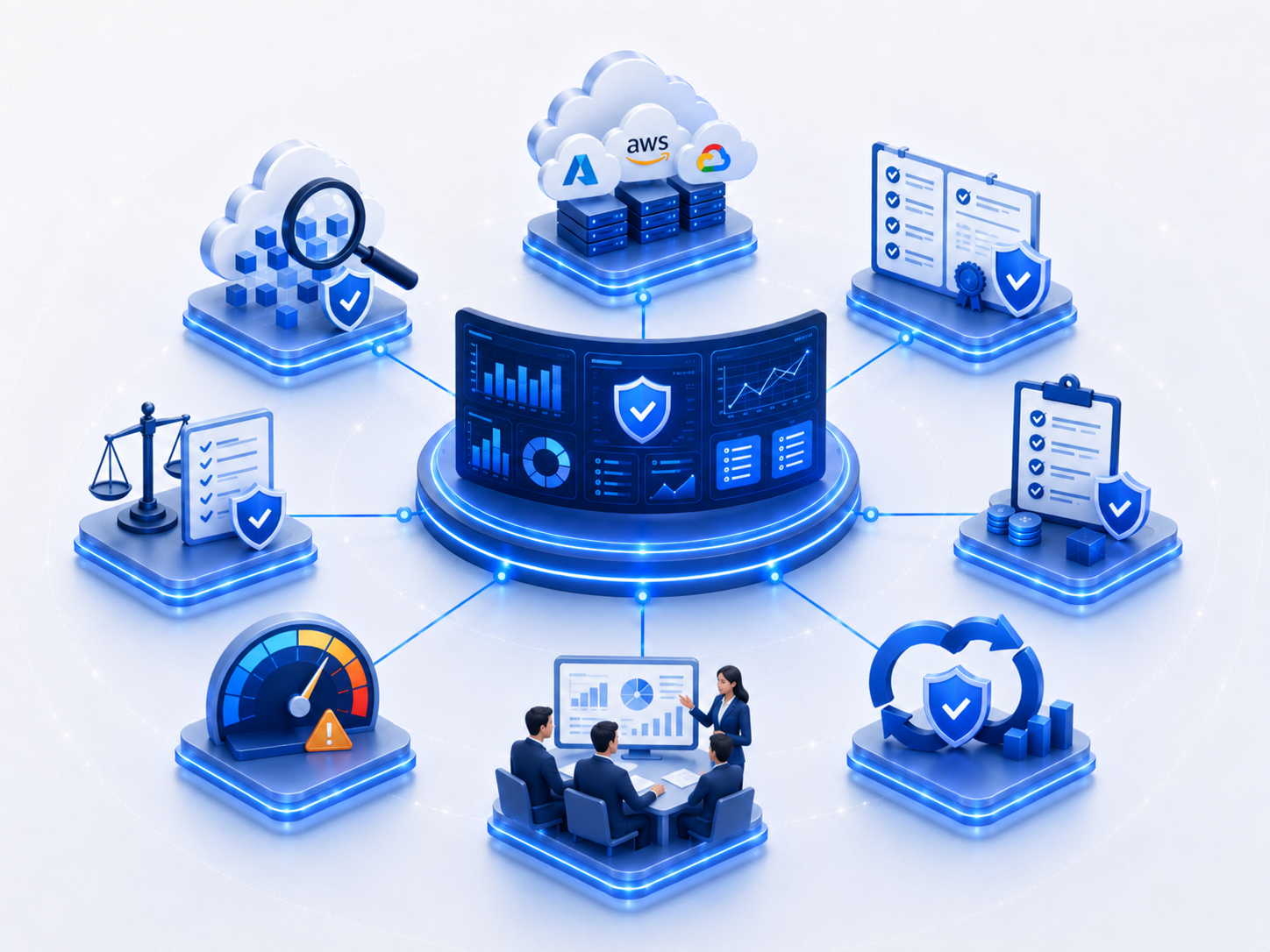
CliffGuard combines cloud discovery, posture assessment, risk prioritization, compliance mapping, remediation validation, and executive reporting to reduce cloud exposure and maintain continuous assurance.

🔍 Cloud Asset & Exposure Discovery – Identify cloud accounts, services, workloads, storage, databases, networks, and externally exposed resources.
🛡️ Misconfiguration & Control Assessment – Detect insecure settings, weak guardrails, configuration drift, exposed services, and ineffective controls.
🔐 Identity & Privilege Posture Review – Assess excessive permissions, privileged roles, service identities, federation, and least-privilege weaknesses.
📋 Compliance & Benchmark Monitoring – Benchmark controls against CIS, NIST CSF 2.0, CSA CCM, ISO 27001:2022, PCI DSS 4.0.1, and internal policies.
🎯 Risk Prioritization & Remediation – Correlate exposure, asset criticality, control weakness, exploitability, and business impact to prioritize action.
📊 Continuous Posture Monitoring & Reporting – Track cloud-security posture, remediation progress, control drift, trends, exceptions, and risk indicators.
Identify cloud accounts, subscriptions, projects, workloads, storage, databases, networks, identities, and managed services across AWS, Microsoft Azure, Google Cloud, and hybrid environments. Build a centralized inventory that improves asset ownership, visibility, and governance.
Evaluate cloud configurations against secure baselines, CIS Benchmarks, cloud-provider best practices, internal policies, and regulatory requirements. Detect exposed resources, excessive permissions, weak encryption, disabled logging, insecure network rules, and configuration drift.
Analyze findings based on severity, internet exposure, asset criticality, data sensitivity, privilege level, exploitability, and potential business impact. Correlate related weaknesses to identify high-risk attack paths and focus remediation on the most critical cloud exposures.
Develop clear corrective actions, assign responsible owners, establish remediation timelines, and track findings through closure. Support secure configuration changes, policy enforcement, exception management, and validation to ensure identified risks are effectively reduced.
Continuously monitor cloud environments for new assets, configuration changes, policy violations, emerging threats, and compliance gaps. Provide CISO dashboards, posture trends, remediation insights, and executive reporting to support continuous cloud security improvement.
⚙️ Cloud Misconfigurations – Identify insecure defaults, weak configurations, disabled controls, and settings that expose cloud resources.
🌐 Public Exposure – Detect internet-accessible services, storage, databases, management interfaces, APIs, and risky network paths.
🔐 Excessive Permissions – Reveal overprivileged identities, broad roles, unused access, risky service accounts, and weak least privilege.
🧩 Unmanaged Cloud Assets – Discover unknown accounts, shadow resources, abandoned services, ownership gaps, and unmanaged assets.
🔄 Configuration Drift – Identify cloud resources that move away from approved baselines, guardrails, policies, and deployment standards.
📋 Compliance Gaps – Detect missing controls, failed benchmarks, weak evidence, policy violations, and inconsistent implementation.
👁️ Monitoring Blind Spots – Reveal missing logging, incomplete telemetry, disabled alerts, weak detection coverage, and limited visibility.


🧠 Business-Risk Driven CSPM – Connect posture findings to business and security risk.
☁️ Multi-Cloud Coverage – Assess AWS, Azure, Google Cloud, SaaS, and hybrid environments.
🧪 Evidence-Based Validation – Confirm configurations, controls, remediation, and security evidence.
📚 Standards-Aligned Assessment – Map findings to benchmarks, frameworks, and compliance requirements.
🎯 Context-Aware Prioritization – Rank remediation by severity, exposure, and business criticality.
👔 Executive-Ready Reporting – Present posture, gaps, trends, and remediation progress clearly.
Cloud Security Posture Management is a continuous process for identifying cloud misconfigurations, exposed resources, excessive permissions, policy violations, and compliance gaps across public, private, hybrid, and multi-cloud environments.
Cloud environments change frequently and can quickly develop security gaps through configuration errors, new deployments, excessive access, or policy drift. CSPM provides continuous visibility and helps identify these risks before they lead to compromise.
CliffGuard supports Amazon Web Services, Microsoft Azure, Google Cloud Platform, private cloud, hybrid cloud, cloud-native workloads, containers, Kubernetes, databases, storage, and managed cloud services.
CSPM can detect exposed storage, open ports, weak network controls, missing encryption, excessive permissions, disabled logging, insecure identities, configuration drift, policy violations, and compliance gaps.
CSPM continuously assesses cloud configurations against frameworks and standards such as ISO/IEC 27001, NIST, CIS Benchmarks, PCI DSS, SOC 2, GDPR, and HIPAA. It also supports evidence collection, gap tracking, and audit reporting.
CliffGuard prioritizes findings based on severity, internet exposure, asset criticality, data sensitivity, identity privilege, exploitability, potential attack paths, and business impact.
CliffGuard combines cloud security, architecture, identity, compliance, risk management, and executive reporting expertise to deliver CSPM services that improve visibility, reduce cloud exposure, accelerate remediation, and support secure cloud growth.
Cloud posture requires continuous visibility into configurations, access, exposure, and control drift. CliffGuard combines CSPM assessment, risk prioritization, remediation validation, and continuous monitoring to create a path from cloud-security findings to enterprise resilience.
Gain a clear, executive-level view of cloud-security posture across your enterprise. CliffGuard identifies critical misconfigurations, prioritizes cloud risk, validates remediation, and establishes continuous monitoring to support measurable, sustainable security improvement.