











Designed to protect what matters
before threats strike.
Organizations adopting cloud platforms, SaaS applications, containerized workloads, APIs, and hybrid infrastructure must ensure security is designed into the architecture—not added later. Misconfigurations, excessive privileges, exposed services, weak logging, unclear ownership, and inconsistent guardrails can increase attack paths and business risk.
CliffGuard’s Enterprise Cloud Security Architecture Services help organizations assess cloud security posture, strengthen architecture controls, improve identity governance, validate segmentation, protect cloud data, and build practical roadmaps for secure cloud transformation.
Cloud Security Architecture defines how cloud platforms, identities, networks, workloads, applications, APIs, data, and monitoring controls are designed to protect enterprise environments.
Cloud Security Strategy evaluates whether cloud controls, operating models, guardrails, ownership, and governance are appropriately designed and consistently applied across hybrid and multi-cloud environments.
CliffGuard provides a structured pathway from cloud architecture assessment to secure implementation readiness, helping organizations reduce exposure, improve resilience, and align cloud security with business risk.

☁️ Cloud Architecture Assessment – Review cloud design, services, dependencies, trust relationships, and existing security controls.
🔐 Identity & Access Architecture – Design authentication, authorization, federation, least privilege, and privileged-access controls.
🧩 Landing Zone & Guardrail Design – Strengthen account structures, policies, baselines, network controls, and secure deployment patterns.
🧪 Monitoring & Control Validation – Review logs, alerts, telemetry, CSPM findings, detection coverage, and control effectiveness.
🧩 Workload & Container Security – Secure virtual machines, containers, Kubernetes, serverless services, and cloud-native workloads.
Clarify business objectives, cloud platforms, critical services, data sensitivity, compliance drivers, ownership, and shared-responsibility boundaries. This defines the enterprise cloud security architecture scope, protection priorities, regulatory expectations, and measurable success criteria.
Review cloud accounts, landing zones, IAM, networks, workloads, data flows, configurations, logging, monitoring, and security tooling. Findings are compared against secure cloud baselines, CIS Benchmarks, CSA CCM controls, and cloud-security best practices.
Develop target guardrails, least-privilege access, segmentation, encryption, workload protection, monitoring, and policy enforcement. This converts assessment findings into a practical cloud security architecture roadmap aligned with risk, resilience, and business priorities.
Validate selected cloud controls through configuration reviews, access testing, evidence sampling, monitoring checks, and stakeholder walkthroughs. This confirms that cloud security controls, IAM policies, logging, and guardrails operate effectively.
Consolidate cloud architecture gaps, residual risks, remediation priorities, ownership actions, dependencies, and maturity improvements into an executive-ready roadmap for phased cloud security implementation and continuous improvement.
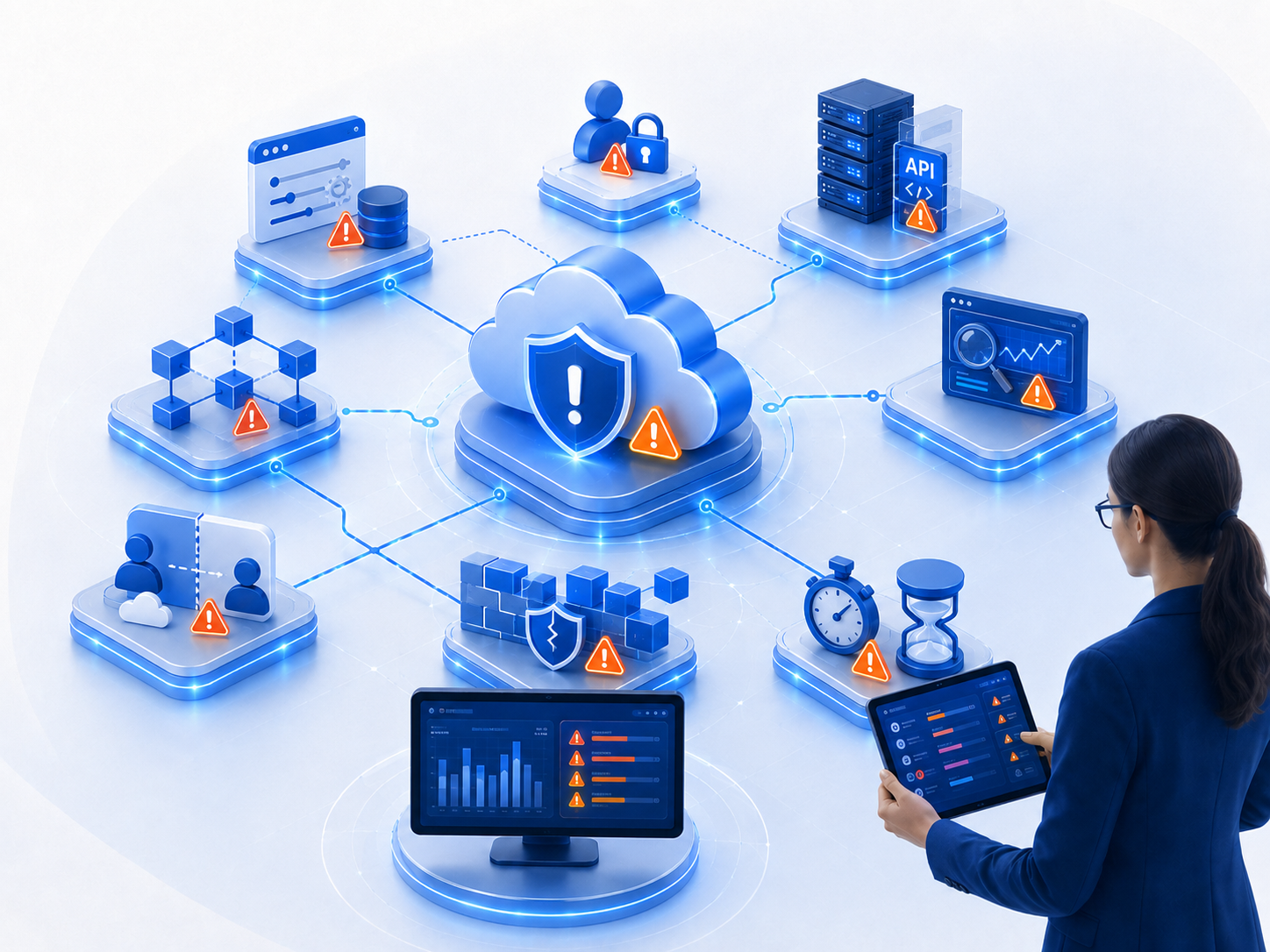
📋 Misconfiguration Risks – Identify insecure services, weak baselines, exposed resources, and inconsistent cloud configuration standards.
🧪 Monitoring Deficiencies – Expose missing, outdated, insufficient, or unreliable visibility into cloud events and security signals.
👤 Ownership Gaps – Identify unclear accountability, undefined responsibilities, and weak governance over cloud-security controls.
🔐 Cloud Access Weaknesses – Review IAM roles, privileged accounts, approvals, federation, service identities, and access reviews.
🤝 Shared-Responsibility Gaps – Assess unclear provider, customer, vendor, and internal ownership across cloud environments.
🚨 Segmentation Weaknesses – Evaluate unrestricted pathways, weak isolation, exposed workloads, insecure APIs, and lateral-movement exposure.
⏱️ Modernization Delays – Identify unresolved findings, unprepared stakeholders, and dependency issues that delay secure cloud adoption.

☁️ Secure Cloud Foundations – Build resilient architectures that support scale, performance, and business growth.
🛡️ Reduced Cloud Exposure – Minimize misconfigurations, attack paths, control gaps, and unauthorized access.
🔐 Stronger Identity & Data Protection – Improve access controls, privilege management, encryption, and data protection.
📊 Greater Security Visibility – Gain clearer oversight of cloud assets, workloads, configurations, and security events.
📋 Improved Compliance Readiness – Align cloud controls with regulatory, audit, privacy, and industry requirements.
🚀 Safer Cloud Transformation – Enable secure migration, modernization, innovation, and multi-cloud adoption.
Enterprise Cloud Security Architecture is the structured design of security controls across cloud platforms, identities, workloads, applications, networks, and data. It ensures cloud environments are secure, scalable, resilient, and aligned with business and compliance requirements.
Cloud environments are dynamic and highly interconnected. A defined security architecture reduces misconfigurations, excessive access, exposed data, weak segmentation, and inconsistent controls before they create business risk.
CliffGuard supports Amazon Web Services, Microsoft Azure, Google Cloud Platform, Microsoft 365, private cloud, hybrid cloud, SaaS platforms, containers, Kubernetes, and cloud-native environments.
A secure cloud landing zone is a standardized cloud foundation that includes account structures, identity controls, network architecture, logging, policy guardrails, security baselines, and governance requirements for deploying workloads securely.
Yes. CliffGuard assesses existing cloud environments, identifies architectural weaknesses, reviews security controls, evaluates risk exposure, and provides prioritized recommendations for improving cloud security and resilience.
Cloud security architecture maps regulatory and framework requirements to technical and governance controls such as encryption, access management, logging, monitoring, data residency, backup, and evidence collection.
CliffGuard combines cloud architecture, cybersecurity, IAM, Zero Trust, workload protection, data security, and compliance expertise to create practical, scalable, and risk-focused cloud security architectures.
Cloud security cannot be improved effectively without understanding current architecture, control effectiveness, and business impact. CliffGuard combines cloud architecture analysis, control validation, identity review, and strategic planning to create a clear path from current-state weaknesses to stronger enterprise resilience.
Gain a clear, executive-level view of cloud security risk and architecture maturity across your enterprise. CliffGuard identifies critical gaps, validates control effectiveness, prioritizes investments, and develops a practical roadmap for measurable, sustainable cloud security improvement.