











CliffGuard vs. Others:
The Web Security Edge
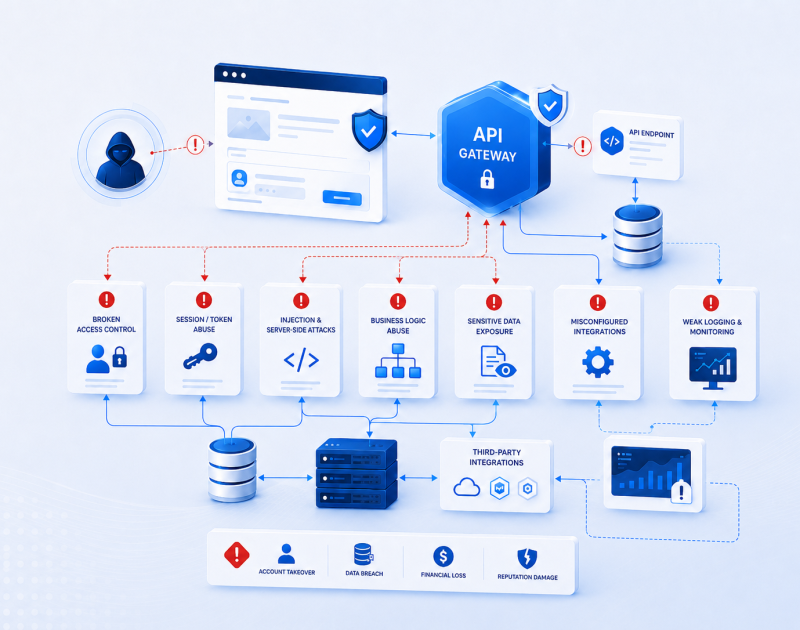
Web applications and APIs power customer portals, SaaS platforms, payments, transactions, integrations, and business-critical workflows. Broken access controls, insecure authentication, injection flaws, exposed endpoints, and logic weaknesses can enable account takeover, data theft, fraud, and operational disruption.
CliffGuard’s Web Application & API Penetration Testing Services combine automated discovery with manual-first testing, role-based assessment, and controlled exploitation. We uncover vulnerabilities missed by scanners, validate their real-world impact, and provide clear remediation guidance for development and security teams.
Web Application & API Penetration Testing is an authorized security assessment that identifies and safely exploits weaknesses across application interfaces, backend APIs, business workflows, and supporting services.
Testing evaluates how attackers could manipulate requests, bypass access controls, compromise accounts, expose sensitive information, abuse application logic, or interact with restricted backend systems.
CliffGuard applies external, authenticated, role-based, and manual testing techniques aligned with recognized OWASP web and API security practices.

🌐 Application Attack-Surface Testing – Assess pages, endpoints, parameters, technologies, files, integrations, and exposed functionality.
🔐 Authentication & Session Testing – Test login, MFA, password recovery, tokens, cookies, session handling, and account-security controls.
🚫 Authorization & Role Testing – Identify object, property, function, role-based, privileged-access, and tenant-isolation weaknesses.
💉 Injection & Input Validation – Assess SQL, NoSQL, command, template, XML, header, file-processing, and client-side injection paths.
🔗 API & Integration Security Testing – Test REST, SOAP, GraphQL, WebSockets, schemas, rate limits, inventories, and third-party integrations.
⚙️ Business Logic & Data Protection – Identify workflow abuse, race conditions, misconfigurations, exposed secrets, and data risks.
We start by defining a clear scope for the web application penetration test, identifying key modules, user roles, APIs, and sensitive data flows. This ensures targeted and effective web application security testing tailored to your infrastructure.
Our team maps your application’s attack surface by discovering endpoints, parameters, and technologies in use. This step mimics a real attacker’s recon phase and is vital for a complete vulnerability assessment.
We identify security weaknesses using automated scanners and expert manual OWASP penetration testing. This includes detecting flaws like SQL injection, cross-site scripting (XSS), and broken access control.
Each discovered vulnerability is safely exploited to demonstrate real-world risk. This process helps you prioritize threats based on impact, strengthening your web application security posture.
You’ll receive a detailed penetration testing report with risk scores, technical details, and step-by-step remediation guidance. All issues are mapped to standards like OWASP Top 10, ISO 27001, and PCI DSS.
After fixes are implemented, we perform a retest to ensure all vulnerabilities are resolved. Our team also provides ongoing support and secure coding best practices to help prevent future risks.
🚫 Broken Access Control – Identify unauthorized object access, privilege escalation, function abuse, and tenant-isolation failures.
🔐 Authentication & Session Failures – Detect weak login controls, token flaws, session abuse, insecure recovery, and account takeover paths.
💉 Injection & Server-Side Attacks – Identify SQL injection, command injection, SSRF, deserialization, and server-side execution risks.
🖥️ Client-Side & Browser Weaknesses – Detect XSS, CSRF, DOM-based flaws, insecure storage, and browser-control weaknesses.
⚙️ Business Logic & API Abuse – Validate workflow bypass, transaction manipulation, automation, replay, and sensitive business-flow abuse.
📂 Sensitive Data Exposure – Identify excessive API responses, insecure transport, weak encryption, exposed files, and information leakage.
🔗 Misconfiguration & Integration Risks – Detect insecure CORS, debug interfaces, shadow APIs, deprecated endpoints, and unsafe third-party integrations.
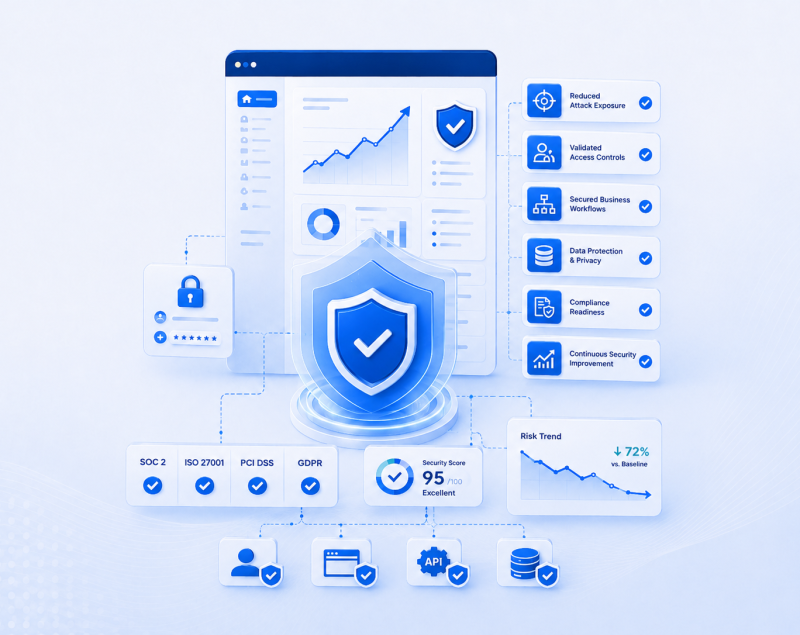
🌐 Reduced Application Exposure – Identify weaknesses before attackers exploit applications, APIs, or systems.
🔐 Stronger Access Security – Improve authentication, authorization, session management, and user-role enforcement.
📚 Standards-Aligned Testing – Align assessments with OWASP Top 10, OWASP ASVS, WSTG, NIST, PCI DSS, and industry practices.
🧠 Protected Business Workflows – Prevent transaction abuse, process manipulation, fraud, and application misuse.
📂 Improved Data Protection – Reduce unauthorized access, information leakage, and sensitive-data exposure.
Web Application Security Testing identifies vulnerabilities across web interfaces, APIs, authentication mechanisms, sessions, access controls, business workflows, and supporting technologies that attackers could exploit.
Vulnerability scanning automatically detects known weaknesses. Penetration testing combines automated tools with expert-led manual analysis, exploitation, business-logic testing, and risk validation to uncover deeper and more complex security flaws.
We test for injection attacks, cross-site scripting, broken access controls, authentication weaknesses, session flaws, insecure file uploads, SSRF, security misconfigurations, vulnerable components, API risks, and business-logic abuse.
Yes. Our testing methodology aligns with the OWASP Top 10, OWASP Web Security Testing Guide, OWASP ASVS, and other recognized security frameworks while extending beyond checklist-based testing.
Yes. We test applications during development, staging, pre-production, major releases, cloud migrations, and after significant code or architecture changes to identify vulnerabilities before public deployment.
The report includes an executive summary, validated findings, severity ratings, affected endpoints, evidence, proof of concept, business impact, reproduction steps, remediation guidance, and recommended security improvements.
CliffGuard combines manual-first penetration testing, application security expertise, business-logic analysis, API testing, attacker-focused validation, and practical remediation support to deliver accurate and actionable web application security assessments.
Security controls cannot be trusted without evidence that they work against realistic attack techniques. CliffGuard combines breach simulation, control validation, detection analysis, and remediation testing to convert defensive weaknesses into measurable security improvements.
Gain a clear, executive-level view of security-control effectiveness across your enterprise. CliffGuard identifies defensive gaps, validates detection coverage, prioritizes remediation, and establishes repeatable testing for measurable and sustainable cyber resilience.